home
previous archive
#afterlife
July 8. I'm pretty sure that out of all the belief systems in human history and prehistory, there's only one that does not believe in an afterlife: physicalism, a.k.a. materialism: the belief that mindless matter is the fundamental reality.
And yet, physicalism has been undermined again and again by its own experiments. The word "quantum" is thrown around a lot, and I think this is an example of the saying "The finger pointing at the moon is not the moon." The double-slit experiment is just a signpost, rising from physicalism, and pointing to psychism. It tells us that the fundamental reality is not the particle but the observer, that time and space and number and measure are like the rules for a game played by pure consciousness. You don't have to know anything about quantum physics to understand this. Leibniz (who also invented calculus) understood it 300 years ago with his concept of monads:
The only things that could be called real were utterly simple beings of psychic activity "endowed with perception and appetite." The other objects, which we call matter, are merely phenomena of these simple perceivers.
Going back to the afterlife, what happens to the monad that's now being you, when it leaves the game? There's a lot of evidence on this subject from near-death experiences. A common objection to NDEs is that those people must not have been really dead, but this is an example of the No true Scotsman fallacy. People have been dead by every clinical definition, including having no brainwaves, sometimes for multiple days, and have come back with reports.
These reports have less in common than you've been told. Not everyone goes down a tunnel to the light, or is greeted by family members. I heard about a guy who was greeted by John Belushi in a bee costume. Some NDEs are so out-there that the person can't even explain them in words. But this Reddit post generalizes from the bulk of reports: What The Afterlife is Like, Based on 100+ Years of Evidence.
Personally I have a variation of Pascal's wager. Pascal was like, "What if the wrathful Christian God is real? I'd better believe in him just in case." I'm thinking, "What if we get to write our own afterlife?" Surely it's not that simple, but what have I got to lose, if I imagine it in detail? This Reddit thread includes my answer from six years ago: If you actually go to a paradise after you die, but the paradise automatically is set up in a way which will be the absolute maximum best and pleasing experience for you, how would your paradise be like?
So, if the afterlife is so great, what are we doing in this dystopia? There are many answers to this question, which I'm not going to get into, but another thing that NDE-ers generally agree on is that suicide is a bad idea. I can make sense of this with the metaphor of walking out of a movie. You might walk out if it's near the end, you're not enjoying it, and you're ready to go home. But you don't want to walk out during the most intense part -- that's why you went to the movie in the first place.
#afterlife2
July 10. A few loose ends on the afterlife.
Epistemological: I don't trust hypnotic regression nearly as much as in-the-wild NDEs. The way reality works, the hypnotist will influence results even with no leading questions.
Ontological: The total of all reports available to us must still be a drop in the ocean of out-of-this-world realms. Eric comments, "Those NDEs have been in the bardo for what? 20 minutes, and now they know all about it?"
Practical: Thinking about the afterlife is a distraction from focusing on the here and now, in which each moment is potentially heaven.
Political: If this world is, metaphysically, a place of pain and hardship, that's why the left can never win. At the same time, this is a place of flux and upheaval where authoritarianism can never hold on for long.
Theological: The biggest perk of physicalism is that you don't have to explain evil, because it's all meaningless. If there's mind behind matter, then why has mind done all this shit? This is usually framed as "How can a benevolent and omnipotent God allow evil?" But I don't believe in that kind of deity. I was raised Catholic, and by its terms I no longer believe in God the Father, but God the Holy Spirit totally makes sense. The benevolence of the universe is omnipresent but subtle. It's like the ocean wearing away rocks, or like the house advantage in gambling. Evil gets a lot of wins, but inevitably, reality bends toward playfulness, aliveness, and feeling good for everyone.
#worldcup
July 20. World Cup roundup. Assist of the tournament: Cucho Hernandez for Colombia vs Uzbekistan, in which he gets rolled over and still scraps it out for a perfect long-range cross.
Goal of the tournament: Rafik Belghali for Algeria's first goal against Austria. The play starts with a long pass that bounces off the corner post, a defender drags down an attacker, Belghali picks it up, beats one defender by bouncing the ball off his nuts, weaves around two more defenders and buries it.
Honorable mention: Erling Haaland's second goal against Brazil, a casual sniper strike that was widely recognized as having the same vibe as an action hero walking away from an explosion.
Match of the tournament: France vs England for third place, in which England went up 4-0 and France made it interesting.
Team and player of the tournament: Cabo Verde, a tiny island nation, earned 90 minute draws against both finalists, and played eventual champion Spain better than anyone, largely through the heroics of 40 year old goalkeeper Vozinha.
#motorwaycity
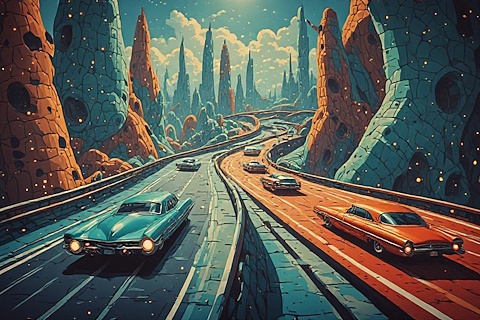 July 24. Continuing on AI, I've said this before: The value of anything that AI does, seems to be inversely proportional to the hype. So the most hyped things, like AI becoming actually intelligent, or replacing all jobs, are going to fail spectacularly. Meanwhile, AI is doing cool stuff in areas that are either too specialized, or too silly, to get hyped. An example of the former: AI is designing radio chips that humans couldn't even imagine.
As an example of the latter, I want to go into more detail about my process of making videos, because I haven't heard of anyone else doing it the same way, using free images and being very picky. I just love to exercise aesthetic judgment, and this practice is independent of the source: you can do it with houses or seashells or random paint splatters. Doing it with AI is like walking through an infinite museum.
Before AI, I did the same thing with human-made images, and the human ceiling is definitely higher, but it's also harder to get there. For International Dateline I scoured the Imaginary Colorscapes subreddit and used everything good that I found. For Holiday I scoured Danbooru, and if you think being a human illustrator is a badge of honor, you should have seen Danbooru before AI, it was even worse.
On a scale of 1-10, most human-made images are 1-5 -- but 10s are possible, and finding a 10 among 3s is worth a thousand thumbnails. Most AI images are 4-7, and picking 7s from 6s is subtle. The less I can explain it, the more I like it. It's funny, both my dad and my grandfather loved fishing, and I never got into it, but this is not that different. I keep throwing lines into the deep and seeing what's on the other end. Getting an 8 is only a matter of patience, and 9s are possible.
For prompts, I always start with lyrics from the song. If they're dense enough, I can go line by line. That's not the case with the video I just finished, Hawkwind's Motorway City, which has just one verse, one chorus, and a long outro. I'm matching sounds as much as words, but the full chorus prompted its own images surprisingly well, and the first half of the verse was perfect for a whole other part of the song.
To cover the rest of the song, I had to develop new prompts, and this is a satisfying iterative process of testing different combinations of words until I find one that clicks. The first prompt I tried was "sleek cars zip along winding motorways in a future utopian city." I plugged it into a bunch of styles, and the results were lame. It turns out that AI is bad at speculative cars, because it likes to copy cars that already exist. The image above was the best of those, and it's not in the video, because the image that opens the video convinced me to redo the whole thing as a journey from the POV of the driver. That way I could focus on cityscapes and landscapes, which AI is better at. Fruitful prompts included "a rain-slicked street in a colorful futuristic city" and "zipping away at blurring speed down a psychedelic highway."
Even at the sweet spot I'm only saving around one image in five. They go in a folder for further filtering, with numbers at the fronts of their filenames, so I can test the video by clicking through the folder while listening to the song. There must be an app that makes this easier, but I like low-level work, and I do a lot of fiddly changing of filenames. For this video, I had so many decent rejected images that I stacked them at the end under the prefix "99-". Then whenever I still wasn't satisfied, I played through the 99s and brought some back. One of them kept catching my eye until I decided to "recast" a whole part of the song to make it fit.
You won't guess which one (3:41) because this is so subjective. It's not like Galileo looking through a telescope. I can't prove that what I'm seeing is real, but it's an empirical practice that anyone can do. I use Perchance, but there are other free generators that I haven't tried. I don't use paid generators because they tend to make images more perfect when I want them weirder. Also, cheaply made images have a much smaller footprint. I've done the math and my carbon emissions over nine months are roughly the same as driving a car ten miles.
By the way, the final image contains a pretty accurate front view of a blue 1948 Dodge pickup, and I never prompted any specific vehicle, but I recognized it immediately. An old blue Dodge pickup is what the protagonist drives in the book that most influenced this video, Roger Zelazny's Roadmarks.
#AItaste
August 7. Great analysis of the implications of AI, Taste Is All That's Left:
Ninety percent of every field is bad.... We have now removed the throttle and left the ratio intact. Ninety percent of an infinite output is still infinite. The signal did not get worse. The noise became free, and free noise rises without limit, and every real thing you make now arrives into a sea of plausible nothing that looks, at a glance, exactly like it.
Which means the scarce act is no longer making. It is choosing. Deciding what, out of the endless generated plausible, deserves to exist and be kept. Curation was a minor virtue when things were expensive to make. It is the whole game when they are free.
People in this thread are using the phrase "AI slop" as if everything made by AI is automatically slop. If you believe this, fair enough, but then you must support the abolition of AI.
If you believe that AI is capable of making good things, then it doesn't matter whether this article, or anything, was AI generated. Whatever it is -- software, prose, images -- if you have taste, you don't have to figure out if it was made by AI or not. All you have to do is apply taste and determine how good it is.
#nolawn
August 10. 170 Years Later: Flowers return after lawn abandoned for film shoot. For the movie 28 Years Later, they left a lawn unmowed, and orchids bloomed that had not been seen there since the 1850s. I continue to think that utopia is easy: there are a lot of very simple things we can do that would make the world much better, and most of them involve just giving up control and letting things go.
#AIproduct
August 19. The Future Of Knowledge Workers In An AI-Driven World, also titled "Why Is Everyone In Tech So Sad?" It covers a lot of stuff, including David Graeber's bullshit jobs and Guy Debord's society of the spectacle. This is the part I find most relevant:
There are two broad categories of Knowledge Workers. The first are outcome-first workers. Their focus is on the business, on winning, on efficiency. Human needs and faults and emotions are an obstacle to be overcome. The second group has an experience-first perspective. These workers love the messy middle. They value the journey.
AI is forcing our whole culture to confront the distinction between product and process. If all you want is the product, fine, let AI crank it out. But AI can never replace the experience of making something. I wrote this in a 2018 post:
Technology saves time and labor with total indifference to whether we enjoy spending time doing certain things. It assumes that we never do -- that sitting and doing nothing while machines do the thing, is always preferable to doing the thing ourselves. Taken to its logical extreme, the message is that nonexistence is preferable to existence. A milder conclusion would be that everything useful should be done by technology. No wonder we increasingly feel that life is meaningless.